
Bad Policy & Empty Plates
July 19, 2026
How poorly informed polices and decisions rooted in neoliberalism produces Food insecurities
The United Nations declared access to FoodFood as a human right, yet Canada, with an abundance of resources and income, fails to uphold the rights of Canadians. Millions of households lack access to affordable, safe, and nutritious Food. Investing In Tomorrow: Future without Poverty (2025) reported that, “in 2024, an estimated 25.5% of people living in the ten provinces, almost 10 million Canadians, lived in a food-insecure household. Half of the 10 million were families with children, reflecting inadequacies in jobs and social supports required to enable working-age families to afford basic needs” {1}.
There is a common misconception that food insecurity results from limited FoodFood or poor individual choices. Mainstream discussions center on individual responsibility, which calls upon the disenfranchised to obtain stronger employment and education. Rising food prices are deemed unenviable, as inflation and other economic factors are also taken into account. The stances highlighted above ignore the structural roles that produce these food inequities. The right to FoodFood has been limited by poor policies, insufficient social safety nets, and the state’s outsourcing of food support to nonprofit organizations {2}.
As outlined in the Investing in Tomorrow: A Future Without Poverty report, income support has played a vital role in poverty reduction, as the pandemic illustrated that child benefits help offset the rising cost of living, preventing many families from falling below the poverty line {1}.
Thus, increasing federal and provincial support, including social assistance, minimum wage, and child benefit wages, alongside further welfare aid, can enable children and families to obtain Food. However, the state has failed to provide income support in a significant and substantive way. Social assistance, such as Ontario Works (OW), falls short, as many OW recipients remain food-insecure and require greater incentives to cover daily expenses{3}.
Instead, the Canadian government has delegated a significant portion of food support to nonprofit organizations. Millions of Canadians use food banks to obtain free or low-cost Food to support their households. Nonprofit organizations have done great work at both the local and national levels to address the high number of users, using an accessible, philanthropic approach. These services, nonetheless, do not have the capacity to support the rising number of households experiencing severe food insecurity {4}. Limited resources and staff often constrain these organizations as they provide short-term relief to Canadians. Measures enacted by nonprofit organizations are band-aid solutions and fail to eradicate food poverty in Canada {4}. The source of food insecurity lies in limited financial aid; therefore, food literacy programs, community gardens, and food banks cannot address acute poverty and produce food security {5}
Deferring to neoliberal policies that center profit over care must end, as Food is a human right that must be low-cost and accessible to all Canadians. There is an active need for an interdisciplinary approach that draws on the agriculture and retail sectors, the Canadian government, nonprofit organizations, and various other Food Actors to enact food security {5}.
Written By: Mariam M
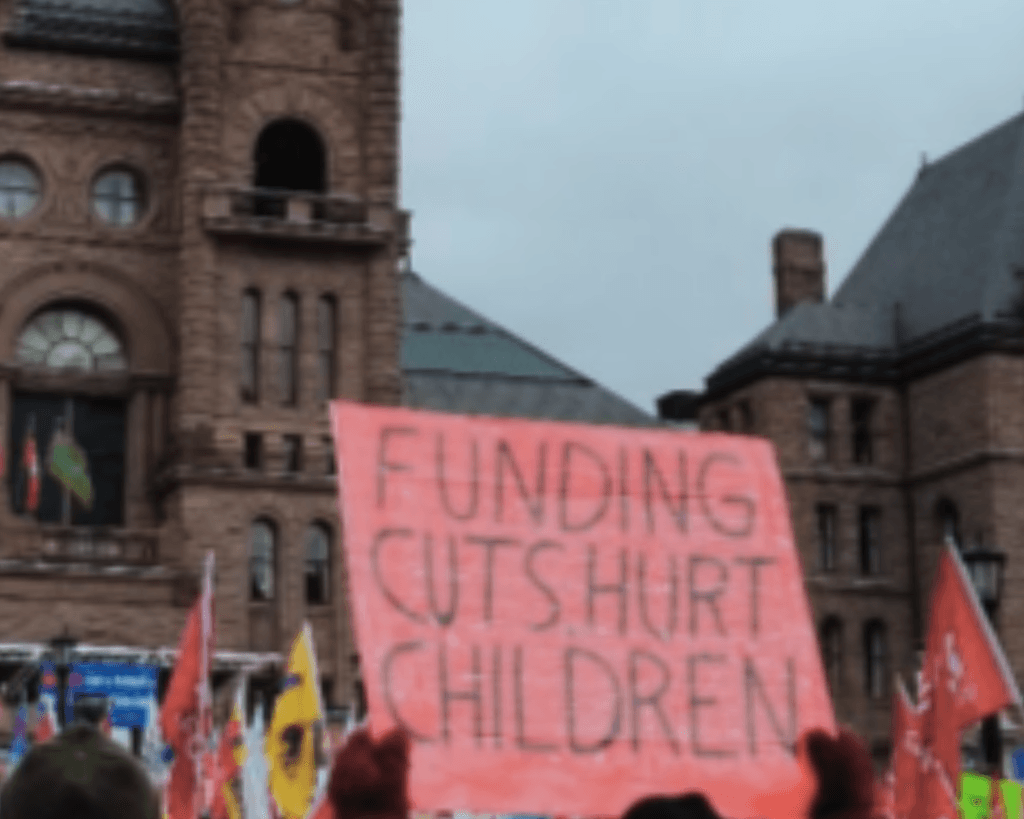
{1} https://campaign2000.ca/wp-content/uploads/2026/02/2025-Report-Card-on-Child-and-Family-Poverty.pdf ( Featured Photo from report card)
{2} https://proof.utoronto.ca/food-insecurity/what-can-be-done-to-reduce-food-insecurity-in-canada/
{3} https://feedontario.ca/research/hunger-report-2024/
{4} https://righttofood.ca/from-community-food-centres-canada-to-right-to-food/
{5} https://openpolicyontario.com/when-the-food-industrys-fortunes-partly-depend-on-the-existence-of-food-banks-rethinking-roles-in-the-fight-against-food-insecurity-in-canada/