Systems Must Protect Aged-Out Youth

July 3, 2026
Aged-out youth are often between the ages of 16 and 19 who exit institutions such as prisons, child welfare systems, and other institutions into community life. They are a large demographic with unique characteristics, strengths, inner power and resilience. Support for addressing the needs of aged-out youth should draw upon their strengths, personal interests, identity, and knowledge. Their lived experience makes them unique experts, as they oftentimes know what is best for them, thus requiring tailored approaches that align with their goals and needs.
Unfortunately, this demographic is often mischaracterized within institutions, often labelled as “trouble”, and “at-risk”. Their lived experience interacting with systems, alongside their marginalized social locations, heightens their vulnerabilities to individual and structural risk factors. Aged out youth are more than harmful stereotypes; these are individuals with a multitude of complexities, capabilities and assets to contribute to society. Support that values autonomy, dignity, and equity is needed, alongside support that highlights structural causes of their precarity rather than seeking to shift individual blame or victimization.
In 2025, Campaign 2000 collaborated on various national housing-focused initiatives, including the release of the Neha Review Panel’s final report {1}. The Neha Review Panel is a crucial, groundbreaking human rights enforcement mechanism created to address systemic housing insecurity. This vital mechanism is one of the few human rights-centred review panels in Canada that draws on the housing needs and lived experiences of women, Two Spirit, Trans, gender-diverse people, and young people experiencing poverty. Discussion centred on aged-out young people who are vulnerable to housing insecurity, incarceration, and acute poverty. A year after the panel, concerns about aged-out youth transitioning to adulthood remain, as these vulnerable demographic needs are grossly unmet. Policy reform must be implemented and operated through a human rights, intersectional, and anti-oppressive approach.
Individual and structural pathways to poverty are enabled by institutional neglect, as the abrupt and unsupportive transition from institutions to adulthood heightens vulnerability to inequities. Aged-out youth experience individual and structural risk factors related to housing insecurity, poverty, incarceration, and poor health outcomes. Campaign2000 report card finds that “99% of youth under the age of 18 who do not live in a family structure live in poverty”{2}.These factors result from poor skills development, lack of support, institutional neglect, and mistreatment. For example, youth living in groups or foster homes report living in poor and unsafe housing, including unsanitary living conditions and dangerous protocols {3}.With physical restraints and strict guidelines imposed by group workers, their voices are silenced in favour of organizational protocols {3}. In addition to these experiences, aged youth sometimes lack knowledge, such as financial and housing literacy, as well as other vital life skills, to transition into adulthood successfully{4}.
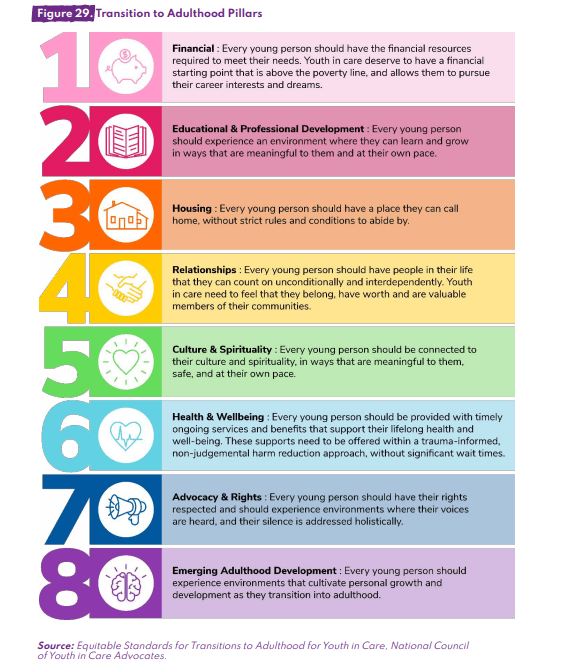
Neoliberal policies, such as cutting government spending on vital social programs, are felt acutely by youths who need support. Poverty-reduction initiatives, ranging from income support to transitional housing and employment services, can help youth successfully exit institutions. Campaign 2000 report card highlights a “2025 report card by the Standing Senate Committee on Youth Aging Out of Care based on the 8 Transition to Adulthood Pillars of the Equitable Standards“{1}.
Racialized youth are disproportionately interacting with institutions such as child welfare and judicial systems, thus requiring anti-discriminatory measures to be enacted to eliminate race-based oppression. Black and Indigenous youth experience discrimination throughout their engagement with institutions, as they are more likely to be separated from their families by child welfare agencies and more likely to receive punitive outcomes than their white counterparts. Anti-Black and anti-Indigenous racism continues after transitioning out of care, as racism is deeply embedded in employment and housing systems, increasing the risk of poverty.
Programs, policies, and practitioners must defer from practices that do not consider race and intersectionality and engage in trauma-informed and culturally safe approaches that recognize and seek to dismantle racial disparities at all levels. Youth need a voice in their care, as their lived experience can help inform stronger interventions and enable self-determination and autonomy. Aged-out Youth are more than their labels; while it is significant to note their marginalization, it is also important to recognize their strength and resilience. There is a significant portion of aged-out young people who successfully transitioned out of care and contribute to society; for some, their capabilities are hindered by structural obstacles. Structural reform must be put in place to eliminate barriers and foster a safe, supportive and inclusive transition for all youth.
Written By: Mariam M
References
{1} https://cms.nhc-cnl.ca/media/Neha/Reports/final-report-and-recommendations-ENGLISH%20(web).pdf
{2} https://campaign2000.ca/wp-content/uploads/2026/02/2025-Report-Card-on-Child-and-Family-Poverty.pdf
{3} https://www.youtube.com/watch?v=tUovRRFHieI
{4} https://www.youtube.com/watch?v=xFedfeuC_aA
{5} Cover Photo retrieved from C2K National Report Card.
Read More At:
- Campaign2000 report card, Investing in Tomorrow: Future without Poverty (2025), calls upon the Canadian government to uphold the promise to eliminate child poverty by the year 2000, read more about the progress here: https://campaign2000.ca/wp-content/uploads/2026/02/2025-Report-Card-on-Child-and-Family-Poverty.pdf
- Watch: Dialogue on Adequate Housing for Families and Preventing Child Apprehension (YouTube).
- Read: Neha Review Panel Final Report.
- Visit: Neha Review Panel releases reports, advocates call for action.